Follow Us x
Our Mission:
Bis-Man Transit delivers valued public transportation, linking people, jobs and communities.
Our Vision:
Our vision is to provide safe, reliable, and efficient public transportation to support the overall quality of life in our communities.
![]()
Our Mission:
Bis-Man Transit delivers valued public transportation, linking people, jobs and communities.
Our Vision:
Our vision is to provide safe, reliable, and efficient public transportation to support the overall quality of life in our communities.
CAT Bus
(701) 323-9228 (Option 1)
Hours of Operation:
Monday- Friday (6:00am-10:00pm)
Saturday (7:00am-10:00pm)
No Service Sunday
Demand response service available 7:30AM Sunday & during holiday service hours on holidays.
Paratransit
(701) 223-9001 (Option 2)
Scheduling Hours:
8:00 AM - 5:00 PM (Monday - Sunday)
Hours of Operation:
Monday-Saturday (5:30am-12:00am)
Sunday (7:30am-6:00pm)
Jefferson Lines Bus Depot Schedule
(701) 450-8651
Depot Hours of Operation:
11:00 AM - 1:30 PM
5:30 PM - 7:00 PM
Eastbound Departure: 12:30 PM
Westbound Departure: 6:30 PM
Bis-Man Transit Administrative Office
(701) 258-6817 (Option 3) Fax: (701) 258-6752
Hours of Operation:
8:00 AM - 5:00 PM (Monday-Friday)


The Bis-Man Transit Board Is a Non-Profit Organization
that provides transit to the communities of Bismarck, Mandan and Lincoln
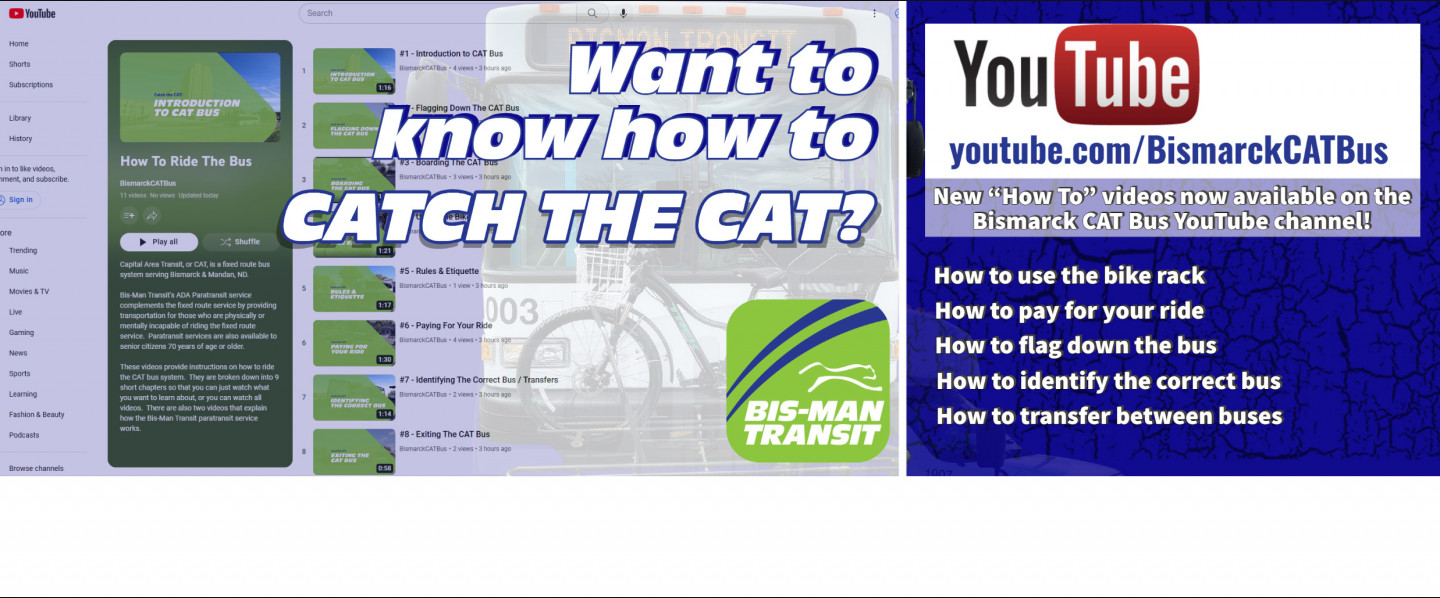
The CAT (Capital Area Transit) is the fixed-route bus system serving Bismarck and Mandan with 6 routes. Running Monday through Friday from 6 a.m. to 10 p.m., and Saturdays from 7 a.m. to 10 p.m. The CAT bus route system allows riders to Catch the CAT by standing on nearly any block corner along the routes and access a bus. On this site, you can learn how to use the CAT by watching our "How to Ride" videos and reading our CAT 101 page. This information will help you learn what to pay for fares and what promotions you may be eligible for, along with bus route information (timing points, route detours, etc.).
If you are traveling throughout North Dakota, the Bismarck-Mandan Transit Center is also home to a Jefferson Lines bus depot that can help you easily get to the east or western part of the state. Buses traveling east out of Bismarck can connect you to Fargo via Interstate 94, while the bus traveling west travels to Dickinson, before reaching Billings, Mont. Bis-Man Transit's paratransit system is a curb-to-curb demand service for individuals with disabilities, as well as seniors over the age of 70.
Bis-Man Transit will consider every request for reasonable modification from individuals with disabilities. Language assistance for persons with limited English proficiency (LEP) is available free of charge. To request a reasonable modification or language assistance, contact our office at (701)258-6817, on our website by clicking here, or in writing at:
Bis-Man Transit
3750 E Rosser Ave.
Bismarck, ND 58501